
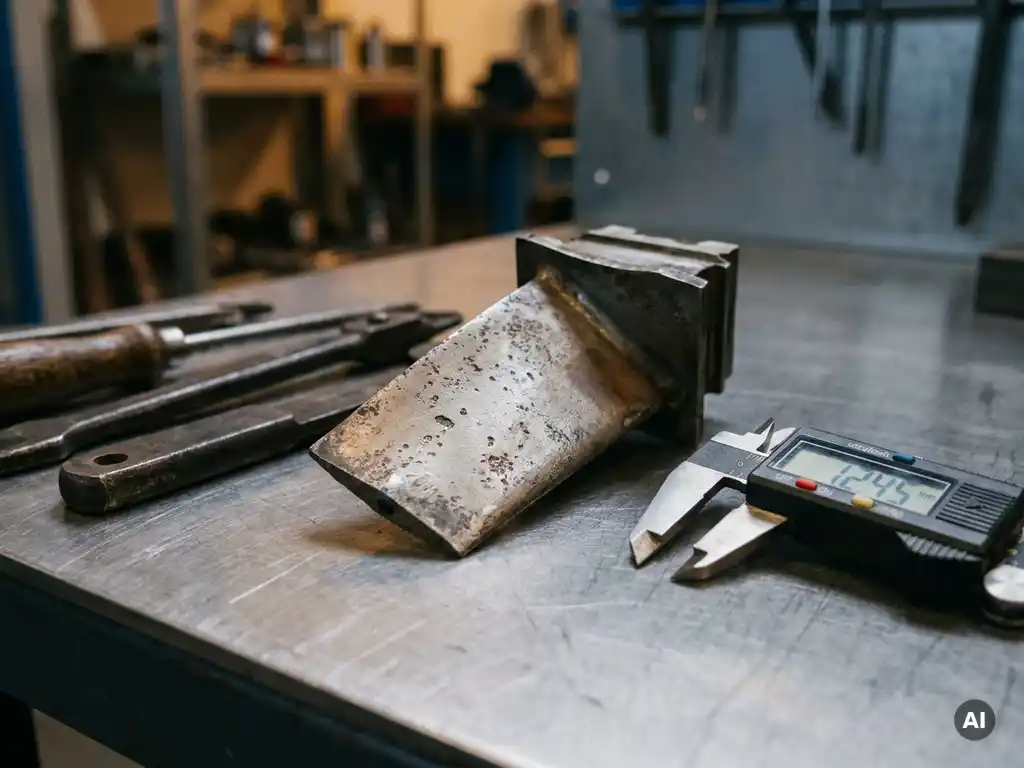
Design for Maintainability (DfM) is an engineering methodology that incorporates ease of maintenance directly into the design of a mechanical system, so that inspection, servicing, repair, and replacement can be carried out efficiently throughout the system’s operational life. Rather than treating maintenance as an afterthought, it shapes decisions about geometry, material selection, component access, and assembly logic from the earliest design stages. The questions below cover how this approach works, what principles guide it, and where it applies in high-stakes environments like aero engines and gas turbines.
How does design for maintainability differ from general design engineering?
General design engineering focuses primarily on making a system perform its intended function reliably under specified operating conditions. Design for maintainability extends that scope by requiring the design team to also consider what happens when the system needs servicing, repair, or component replacement over its full operational life. The distinction lies in whose needs are being prioritized: performance engineers optimize for output, while maintainability engineers optimize for the technician working on the system years after it leaves the factory.
In practice, this means a maintainability-focused designer asks questions that a purely performance-focused designer might not. Can a technician reach that fastener with standard tooling? How long does it take to remove a worn component without disturbing adjacent systems? Are inspection points accessible without full disassembly? These questions do not change the primary function of the system, but they have a significant effect on how much time, cost, and risk accumulate over the system’s service life.
For industries like aerospace engineering, where systems operate for decades and maintenance windows are tightly scheduled, this distinction carries real consequences. A design that is 5% more efficient but takes twice as long to service may generate greater lifecycle costs than a slightly less optimized design that is straightforward to maintain.
What are the core principles of design for maintainability?
The core principles of maintainability engineering guide how a system is structured so that maintenance tasks are safe, fast, and repeatable. These principles are applied during the design phase, not retrofitted after production.
- Accessibility: Components that require frequent inspection or replacement should be reachable without removing unrelated parts. Poor access is one of the most common sources of maintenance time loss.
- Standardization: Using common fastener types, connectors, and interfaces reduces the tooling and training burden on maintenance teams and lowers the risk of assembly errors.
- Modularity: Designing systems as discrete, replaceable modules allows a faulty unit to be swapped quickly, reducing downtime while the original component is repaired separately.
- Fault isolation: The system should make it straightforward to identify which component has failed, through built-in diagnostics or clear physical separation of functional zones.
- Minimal disassembly: Maintenance tasks should require the removal of as few parts as possible. Every additional step in a maintenance procedure adds time and introduces the possibility of reassembly error.
These principles are not independent. A modular design that lacks proper accessibility still creates maintenance problems. Effective maintainability engineering applies them together as a coherent design philosophy rather than as a checklist.
How does maintainability affect lifecycle cost in mechanical systems?
Maintainability has a direct and measurable effect on lifecycle cost. For most complex mechanical systems, the cost of ownership over the operational life significantly exceeds the initial acquisition cost, and a large share of that operational cost comes from scheduled and unscheduled maintenance activities.
When a system is designed without maintainability in mind, maintenance tasks take longer, require more specialist labor, and carry a higher risk of secondary damage during disassembly. These effects compound over time. A component that takes four hours to replace instead of one hour generates three hours of additional labor cost every time it is serviced, across every unit in the fleet, across every service interval over the system’s life.
Beyond labor, poor maintainability also affects availability. Systems that spend more time in maintenance are available for fewer operational hours, which has direct commercial or mission consequences depending on the application. In sectors like gas turbine operation, where downtime carries significant financial penalties, this availability factor is often the dominant driver of maintainability investment during the design phase.
What tools and methods are used to evaluate maintainability during design?
Several structured tools and methods are used to evaluate and improve maintainability during the design phase, before a physical prototype is built. These methods allow engineering teams to identify maintenance problems early, when changes are far less expensive to implement.
Maintenance task analysis
Maintenance task analysis (MTA) breaks down each anticipated maintenance activity into individual steps, estimating the time, tools, and skills required for each. This produces a detailed picture of maintenance burden across the system and highlights where design changes would have the greatest impact on serviceability.
Failure mode and effects analysis
Failure mode and effects analysis (FMEA) identifies potential failure modes within a system and evaluates their consequences. When applied with a maintainability lens, it also considers how detectable each failure is and how quickly it can be corrected, feeding directly into decisions about diagnostic systems and component accessibility.
Digital tools have become increasingly important in this area. Three-dimensional CAD environments allow engineers to simulate maintenance procedures virtually, checking whether a technician’s hand can physically reach a component or whether a part can be extracted without interference. This virtual maintainability analysis can identify problems that would otherwise only surface during physical prototype testing, where corrections are far more costly.
How does design for maintainability apply to aero engines and gas turbines?
Aero engine and gas turbine design represents one of the most demanding applications of maintainability engineering. These machines operate under extreme thermal and mechanical loads, contain hundreds of precision components, and must meet strict safety and certification requirements. At the same time, they are expected to remain in service for decades, with maintenance carried out on tight schedules by technicians who may be working in field conditions.
In this context, maintainability decisions affect everything from how turbine blades are attached and removed, to how borescope inspection ports are positioned, to how modular engine sections are designed for line-replaceable unit (LRU) swaps. Engine manufacturers invest heavily in designing for on-wing maintenance, meaning that many routine tasks can be completed with the engine still mounted on the aircraft, avoiding the cost and time of full removal.
Testing plays a central role in validating these design decisions. Aerothermal component testing, for example, generates data that informs not only performance characteristics but also the wear patterns and failure modes that maintenance schedules are built around. Understanding how a compressor stage degrades under real operating conditions allows designers to specify appropriate inspection intervals and access requirements before the engine enters service.
What is the difference between maintainability and reliability in engineering?
Maintainability and reliability are related but distinct engineering properties. Reliability measures how long a system or component operates without failure. Maintainability measures how quickly and efficiently the system can be restored to operational condition after a failure or scheduled service event. Both matter for overall system availability, but they address different aspects of the problem.
A highly reliable system fails infrequently, reducing the total number of maintenance events required. A highly maintainable system can be serviced quickly when maintenance is needed, reducing the time lost to each event. The two properties interact: a system with moderate reliability but excellent maintainability may achieve higher operational availability than a system with high reliability but poor maintainability, depending on how long each maintenance event takes.
Engineers working on availability-critical systems typically model both properties together using metrics like mean time between failures (MTBF) for reliability and mean time to repair (MTTR) for maintainability. Improving one without considering the other can produce suboptimal outcomes. A design change that increases component life but makes replacement far more complex may reduce overall availability even as it improves reliability on paper.
How AneCom supports maintainability in aero engine and gas turbine development
AneCom AeroTest provides engineering and testing services that directly support maintainability objectives in gas turbine and aero engine development. Through its capabilities in design and analysis, instrumentation, and aerothermal component testing, AneCom generates the validation data that underpins informed decisions about inspection intervals, wear behavior, and component life.
- Aerothermal testing of compressors, combustors, and turbine components to characterize real-world degradation and inform maintenance planning
- Non-destructive testing services to inspect components without disassembly, supporting condition-based maintenance approaches
- Engineering support for instrumentation and assembly, including at customer sites worldwide
- Qualified repair services for turbine blades, reducing the cost and lead time associated with component replacement
Whether you are developing a new engine architecture or refining the serviceability of an existing platform, AneCom’s testing and engineering services can provide the technical foundation your maintainability program needs. Contact AneCom to discuss how its capabilities can support your project.
Related Articles
- What information should a mechanical engineering drawing contain?
- What is Design for Assembly and why does it matter?
- How can engineers determine whether a prototype is manufacturable?
- Why are tolerances important on mechanical engineering drawings?
- What are the main design risks in high-speed rotating machinery?