
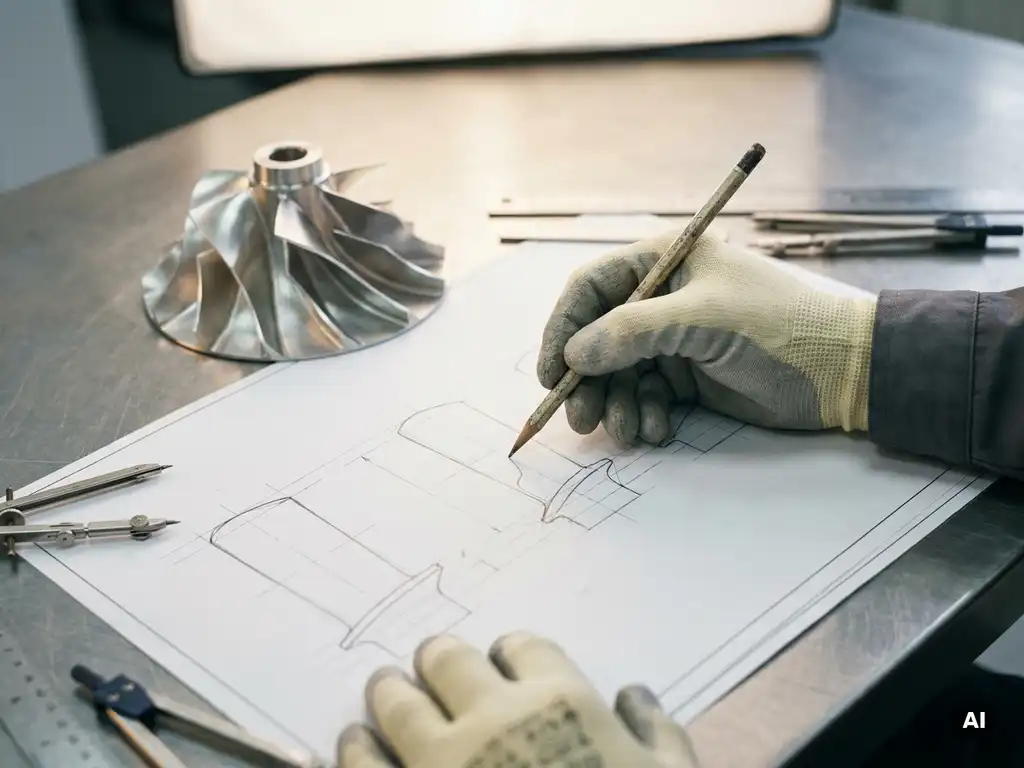
Concept design in mechanical engineering is the early phase of the design process where engineers define what a product or system should do and explore multiple ways to achieve that function. It produces a set of candidate solutions, evaluated against technical and practical criteria, before detailed design begins. The sections below address the most common questions about how concept design works, what it involves, and why the decisions made at this stage have consequences that extend all the way to testing.
How does concept design fit into the mechanical engineering design process?
Concept design is the second major phase of the mechanical engineering design process, sitting between the requirements definition phase and detailed design. It takes a validated set of functional requirements and asks how those requirements can be met, generating and evaluating candidate solutions before any geometry is fixed or components are specified in detail.
Most structured engineering design processes follow a sequence from requirements through concept, embodiment, and detail design, into manufacturing and validation. Concept design occupies the point in that sequence where the design space is widest. Engineers have not yet committed to specific geometries, materials, or manufacturing routes, which means changes are relatively inexpensive to make. Once the process moves into embodiment and detail design, every decision becomes progressively more costly to reverse.
The output of concept design is typically one selected concept, supported by documentation that records the alternatives considered and the reasoning behind the selection. This record matters because it informs later design decisions and provides traceability during validation.
What are the main activities carried out during concept design?
The main activities in concept design are functional decomposition, idea generation, concept development, and concept evaluation. Together, these activities move a team from a set of requirements to a preferred solution that is ready for detailed development.
Functional decomposition breaks the overall system function into sub-functions that can be addressed independently or in combination. A compressor stage, for example, might be decomposed into functions such as directing flow, adding energy to the fluid, and managing tip clearance. Each sub-function can then be addressed with different physical principles or mechanisms.
Idea generation follows, producing multiple ways to fulfill each sub-function. These partial solutions are then combined into whole concepts, which are developed just enough to be meaningfully compared. Development at this stage is intentionally rough: hand sketches, simplified models, and order-of-magnitude calculations are appropriate tools. The goal is to understand feasibility and trade-offs, not to produce finished designs.
Evaluation then reduces the field of concepts to a preferred option. The team applies selection criteria derived from the original requirements, and the preferred concept is documented and carried forward.
What methods do engineers use to generate concept ideas?
Engineers use structured ideation methods to generate concept ideas, with the most common being morphological analysis, brainstorming, TRIZ, and the use of analogies from other engineering domains. These methods share the goal of expanding the solution space before it is narrowed by evaluation.
Morphological analysis is particularly systematic. The design team lists the sub-functions identified during functional decomposition, then populates a matrix with different physical principles or mechanisms that could fulfill each sub-function. Combining one entry from each row produces a complete concept. A moderately complex system with five sub-functions and four options per function yields over a thousand possible combinations, most of which are impractical but some of which are genuinely novel.
Brainstorming and its structured variants, such as brainwriting, are used to generate ideas quickly in a group setting. The value of these sessions depends heavily on preparation: participants who arrive familiar with the requirements and with examples from adjacent fields generate more useful ideas than those approaching the problem cold.
TRIZ, a systematic innovation methodology developed from analysis of patents across engineering disciplines, provides a library of inventive principles and contradiction resolution strategies. It is particularly useful when a design requirement creates a conflict, such as needing a structure that is both stiff and lightweight, because it directs engineers toward classes of solutions that have resolved similar contradictions before.
How is the best concept selected from multiple options?
The best concept is selected by evaluating all candidates against a weighted set of criteria derived from the product requirements. The two most widely used formal methods are the Pugh concept selection matrix and the weighted decision matrix, both of which make the evaluation transparent and repeatable.
In a Pugh matrix, one concept is designated as a reference and the others are rated as better, worse, or equivalent to it on each criterion. This relative scoring approach avoids the difficulty of assigning absolute scores early in the process, when performance data is limited. The concept with the most favourable ratings is a candidate for selection, though teams often use the results to identify hybrid concepts that combine strengths from multiple options.
A weighted decision matrix assigns numerical scores and applies weights that reflect the relative importance of each criterion. This approach is more precise but requires the team to agree on weights, which is itself a useful discipline because it surfaces disagreements about priorities before they become embedded in the design.
Both methods work best when the selection criteria are set before the concepts are generated, not after. Criteria defined retrospectively tend to favour the concept the team already prefers, which undermines the purpose of the process.
What tools and software support concept design in mechanical engineering?
Concept design in mechanical engineering is supported by a range of tools, from simple structured worksheets to dedicated systems engineering and CAD software. The appropriate tools depend on the complexity of the system and the stage within concept design.
Early in concept design, paper-based tools and whiteboards are often the most productive. Morphological charts, function-means trees, and hand sketches allow ideas to be captured and shared quickly without the overhead of software. Many experienced engineers deliberately avoid detailed CAD at this stage because it encourages premature commitment to geometry.
As concepts become more defined, engineers use CAD tools for rough geometry, simulation tools for order-of-magnitude performance checks, and systems modelling languages such as SysML for complex systems where interactions between subsystems need to be tracked. Model-based systems engineering environments can link requirements to functions to physical components, providing traceability that becomes valuable during validation.
Collaboration platforms and product lifecycle management systems support concept design in larger teams by managing versions of concept documentation, capturing decisions, and maintaining the link between requirements and candidate solutions. For organisations working on mechanical engineering projects across multiple sites or with external partners, this traceability is particularly important.
Why do concept design decisions affect testing and validation later?
Concept design decisions determine which physical principles, architectures, and interfaces are built into a product, and those choices directly shape what needs to be tested, how tests must be configured, and what validation evidence is required. A concept that introduces novel mechanisms or unusual operating conditions typically demands more extensive experimental validation than one built on well-understood principles.
The connection between concept design and testing is most visible in aerothermal systems such as gas turbine components. A concept that adopts a new compressor stage geometry, for example, cannot be validated purely through simulation. Experimental testing under representative aerodynamic conditions is required to confirm performance and stability, and the test facility must be capable of replicating those conditions accurately. Decisions made during concept design about pressure ratios, mass flow rates, and stage counts determine what test infrastructure is needed before detailed design has even started.
Concept decisions also affect the instrumentation strategy. A concept that relies on a particular flow path or cooling arrangement may require measurement access points that are difficult to accommodate in a standard test rig. Identifying these requirements early, during concept design, allows test engineers to plan appropriate solutions rather than retrofit them later at greater cost.
This is one reason why organisations involved in high-stakes development programmes, particularly in aerospace engineering, involve test and validation engineers during concept design rather than treating testing as a downstream activity.
How AneCom supports concept design in mechanical engineering
AneCom AeroTest works with development teams at the point where concept design decisions need experimental validation. For gas turbine and aero engine programmes, this typically means testing compressor stages, fan systems, and aerothermal components under conditions that are representative of real operating environments.
- Aerothermal component testing for compressors, combustors, and turbine parts, carried out at AneCom’s Compressor Test Center in Wildau
- Fan acoustic testing in Europe’s largest anechoic chamber, which suppresses wall reflections below 1% across 200 Hz to 40 kHz, providing free-field acoustic conditions for fan system development
- Design and analysis, instrumentation, assembly, and testing from a single source, including support at customer sites
- Non-destructive testing and support for complex machine maintenance, relevant where concept validation requires assessment of components after test
Involving a specialist test partner early, while concept decisions are still being made, allows development teams to plan instrumentation strategies, identify test infrastructure requirements, and avoid costly surprises during validation. To discuss how AneCom can support your programme from concept through to test, get in touch with the team.
Related Articles
- What is the difference between a prototype and a proof of concept?
- When should engineers build a physical prototype?
- How can conflicting engineering requirements be handled during concept selection?
- How do engineers evaluate technical risk when selecting a design concept?
- When should engineers use a decision matrix instead of engineering judgement?