
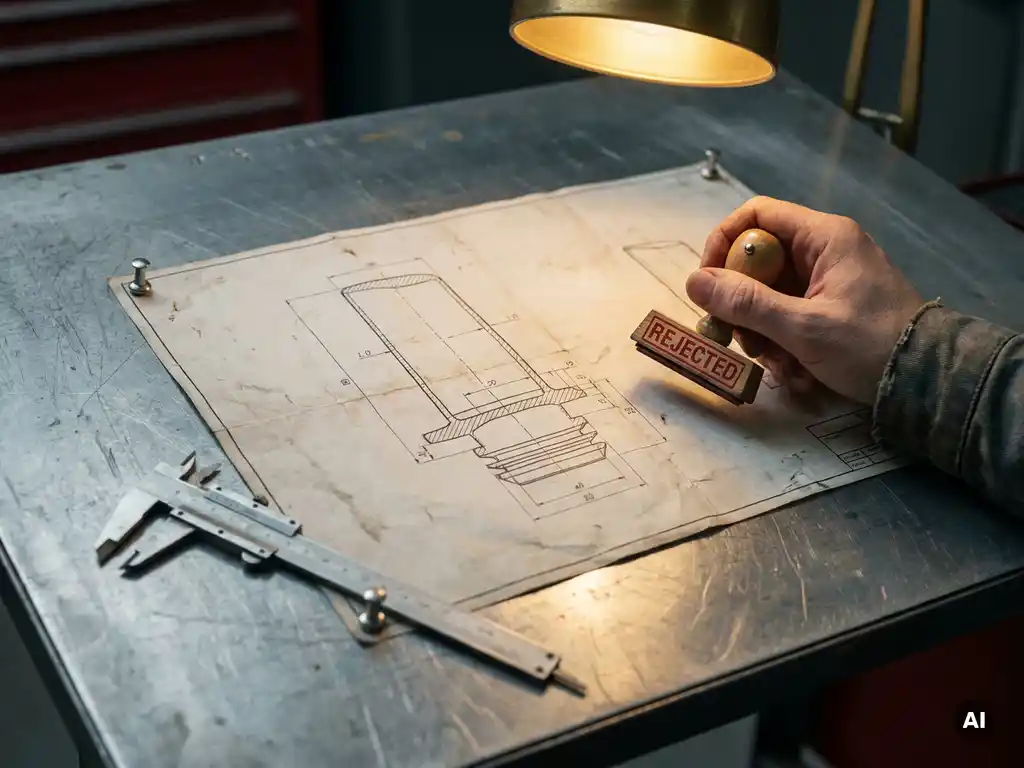
A mechanical concept should be rejected when it cannot meet the core performance requirements within the constraints of physics, cost, or manufacturability, and when further refinement would not change that outcome. The decision is rarely straightforward, but there are reliable signals that distinguish a concept worth developing from one that will consume resources without delivering results. The questions below address the most common points of failure, the methods engineers use to evaluate concepts early, and who carries the responsibility for making the call.
What are the most common reasons a mechanical concept fails early?
A mechanical concept typically fails early because it cannot satisfy one or more of the fundamental constraints set at the start of the design process: performance targets, available materials, manufacturing tolerances, or operational environment. These failures are not always obvious at the concept stage, which is why structured screening matters.
In aerospace engineering, the most frequent early failure modes include thermal limits that the chosen geometry cannot accommodate, structural loads that exceed the material’s capability, and assembly sequences that are physically impossible at the required tolerances. Cost overruns are another common driver, particularly when a concept requires manufacturing processes that are technically feasible but economically unworkable at the intended production volume.
Aerodynamic incompatibility is a recurring issue in compressor and fan design. A concept may look geometrically sound but produce flow conditions, such as separation or surge, that make it unacceptable for the intended operating range. These problems tend to surface during preliminary analysis rather than testing, but only if the analysis is done before the concept is locked in.
How do engineers evaluate a mechanical concept before committing to development?
Engineers evaluate a mechanical concept by applying a structured set of feasibility checks that progress from qualitative screening to quantitative analysis. The goal is to eliminate weak concepts early, before significant resources are committed, by testing each concept against the most constraining requirements first.
The standard approach moves through several layers. A concept screening matrix compares candidate designs against weighted criteria, such as aerodynamic efficiency, structural integrity, thermal management, and producibility. Concepts that score poorly against high-priority criteria are eliminated before detailed analysis begins. This keeps the evaluation focused and prevents teams from investing effort in refining a concept that fails on a fundamental requirement.
After initial screening, engineers apply preliminary analysis tools: computational fluid dynamics for flow behavior, finite element analysis for structural response, and thermodynamic modeling for heat transfer. These tools do not replace physical testing, but they allow teams to identify critical failure modes at low cost. In gas turbine engineering, where the operating conditions involve extreme temperatures, pressures, and rotational speeds, this analytical phase is particularly important because errors discovered late in development carry very high correction costs.
What’s the difference between a flawed concept and a concept that needs refinement?
A flawed concept has a fundamental incompatibility with the design requirements that cannot be resolved by adjusting parameters within the same conceptual approach. A concept that needs refinement has a sound underlying principle but requires iteration on geometry, materials, or boundary conditions to meet its targets.
The distinction matters because the two situations call for different responses. Refinement is a normal part of development and should be expected. Rejection is appropriate when the root cause of a performance gap is structural to the concept itself, not to its current implementation.
For example, a compressor stage concept based on a particular blade geometry may show insufficient pressure rise in initial analysis. If the shortfall is due to a blade angle that can be adjusted, the concept is worth refining. If the shortfall is due to a fundamental mismatch between the chosen design philosophy and the required stage loading, no amount of geometric adjustment will close the gap. That is a flawed concept.
Engineers sometimes struggle to make this distinction clearly, particularly when a team has invested significant effort in a concept. A useful test is to ask whether any realistic change to the concept’s parameters could meet the requirements, or whether meeting the requirements would require abandoning the concept’s defining characteristics entirely.
When is it too late in the design process to reject a mechanical concept?
There is no point in the design process at which rejection becomes impossible, but the cost and disruption of rejection increase substantially at each phase gate. Rejecting a concept during initial screening costs almost nothing. Rejecting it after detailed design, tooling investment, or prototype manufacture can set a program back by months and consume a significant portion of the development budget.
In practice, the critical decision point is the transition from concept design to detailed design. This is the gate at which teams commit to a specific architecture and begin allocating significant engineering hours to its development. Concepts that have not been validated against their most demanding requirements by this point carry serious risk.
Late-stage rejection, while costly, is still preferable to proceeding with a concept that will fail in testing or service. Programs that discover fundamental concept flaws during rig testing or system integration face far greater costs than those that reject concepts early. The discipline required to make hard rejection decisions at concept review is one of the most valuable practices in engineering program management.
Who should have the authority to reject a mechanical concept?
The authority to reject a mechanical concept should rest with a cross-functional team that includes the lead engineer for the relevant discipline, the program manager, and representatives from manufacturing and systems integration. No single person should have unilateral authority to reject or approve a concept, because the consequences of the decision span multiple domains.
In practice, the lead discipline engineer, such as the aerodynamics lead in a compressor design program, carries the technical weight of the recommendation. Their analysis of whether the concept can meet performance requirements is the primary input. But the final decision should account for schedule risk, cost implications, and the availability of alternative concepts, which requires broader input.
Independent technical review, conducted by engineers who have not been involved in developing the concept, adds significant value at this stage. Reviewers without ownership of the concept are better positioned to assess its weaknesses objectively. For high-stakes programs in the gas turbine industry, external review panels or independent development service providers are sometimes engaged specifically for this purpose.
What testing methods reveal whether a mechanical concept is viable?
The testing methods used to validate a mechanical concept depend on the stage of development and the specific risks associated with the concept. Early-stage viability is typically assessed through analysis and bench testing of individual components or subsystems. Full system testing comes later, once the concept has passed analytical screening.
For aerothermal concepts in aero engines and gas turbines, the most informative early tests involve rig testing of isolated components under representative conditions. A compressor stage, for example, can be tested on a dedicated compressor test bench to measure pressure ratio, efficiency, and surge margin before it is integrated into a full engine. This approach allows teams to validate or reject the concept based on measured data rather than analysis alone.
Acoustic testing plays a role in fan and intake concept evaluation, particularly where noise certification requirements are part of the design specification. Testing in an anechoic environment, which suppresses reflections and simulates free-field conditions, provides clean data that can be compared directly against certification targets. Concepts that cannot meet acoustic targets under controlled test conditions are unlikely to do so in service.
Non-destructive evaluation methods, including ultrasonic inspection and computed tomography, are used to assess whether prototype hardware meets the geometric and material requirements of the concept. These methods can reveal manufacturing defects or material inconsistencies that would compromise the concept’s performance before any operational testing takes place.
How AneCom supports concept validation in aero engine and gas turbine development
AneCom AeroTest provides independent testing and engineering services that directly support the concept evaluation process described throughout this article. For development programs where early rejection decisions depend on measured data rather than analysis alone, AneCom offers:
- Compressor and fan rig testing at its Compressor Test Center, covering multistage compressor systems and aero engine fans under representative aerodynamic conditions
- Acoustic testing in Europe’s largest anechoic chamber, with noise reflection below 1% across the 200 Hz to 40 kHz frequency range, providing clean data for fan concept screening against noise targets
- Combustor and turbine test services through cooperation partners, extending concept validation across all major aerothermal components
- Non-destructive testing of prototype hardware to verify geometric and material conformance before operational testing begins
- Independent engineering analysis and design review services, including instrumentation and data acquisition for complex test vehicles
Because AneCom operates independently of the major OEMs, its test data and engineering assessments carry the objectivity that internal teams sometimes cannot provide when evaluating their own concepts. If your program is approaching a concept decision point and needs validated test data to support it, contact AneCom to discuss how its facilities and engineering services can be applied to your specific requirements.
Related Articles
- How do engineering teams compare alternative mechanical concepts?
- How do engineers convert a design concept into manufacturable geometry?
- What should engineers consider when designing rotating components?
- When should Design for Manufacture be considered during product development?
- When should engineers use a decision matrix instead of engineering judgement?